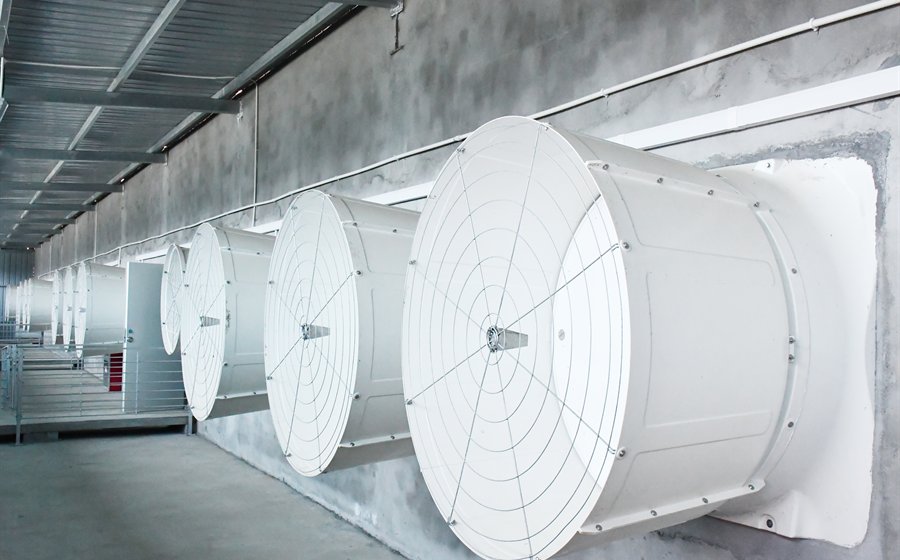
A pig ventilation fan should be compared against the conditions in which it will operate, not chosen by nominal diameter alone. Before an equipment discussion, buyers can organize the rated data, installed components and project information that make one fan comparison meaningful.
Why Fan Size Alone Is Not Enough
Diameter is a visible characteristic, but it does not by itself show how much air a fan will deliver in a particular installation. Iowa State Extension explains that air delivery and efficiency should be considered at relevant static pressures, and that fans of the same nominal size can perform differently. A buyer should therefore ask for comparable rated information rather than treating size as a complete specification.
7 Technical Factors to Check Before Choosing a Pig Ventilation Fan
1. Required Airflow Context
Start with the project context: house dimensions, pig stage, season or climate context, existing ventilation arrangement and the purpose of the equipment discussion. These inputs frame a comparison; they are not a substitute for a site-specific airflow calculation or a guaranteed fan count.
2. Operating Static Pressure
Static pressure describes resistance against which an exhaust fan operates. Inlets, openings and other parts of the air path influence that operating condition. Compare airflow data at the relevant stated pressure point instead of comparing a single free-air figure with an installed application.
3. Rated Fan Performance
Ask whether a performance table or curve identifies airflow against static pressure and the conditions used for the rating. Iowa State’s swine worksheet uses fan test data as an input to component selection. Where independently rated or certified information is available, it gives buyers a clearer basis for comparing like with like.
4. Fan Efficiency
Efficiency is another comparison field, often expressed as air delivery relative to electrical input in rated data. It should be read together with the stated rating condition and equipment arrangement. This guide does not set a universal threshold or make an energy-saving claim for any KAMOF configuration.
5. Installed Accessories and Resistance
Shutters, guards, cones, ducts where applicable, and other fitted components can affect resistance and installed performance. Do not assume a bare-fan value will describe a complete arrangement. Record the accessories included in the comparison and ask whether the supplied data identify their treatment.
6. Inlets, Controls and Electrical Inputs
A fan works within a system of inlets, controls and electrical supply. Buyers should identify the current or intended control method, power-supply requirement, fan locations and inlet arrangement. That information supports a configuration discussion; it is not an electrical design or a compatibility promise.
7. Pig-House and Project Information
Prepare dimensions, photographs or layout, pig stage as project context, existing ventilation type, intended fan locations, inlet arrangement, electrical information, quantity and destination. A pig ventilation fan enquiry is more useful when these facts accompany the request, because they show the conditions that the rated information must relate to.
How to Read a Fan Performance Table or Curve
Read the pressure condition and airflow value together. A curve or table is useful only when the buyer can identify the test or rating basis and compare the same condition across options. AMCA’s agricultural-fan rating material illustrates why standardized rating concepts are useful where they are available; it does not mean that every fan, or any KAMOF product, carries an AMCA certification.
Ask whether the stated data identify the test condition, the relevant airflow point and the configuration to which the rating applies. A number without that context is difficult to compare fairly. The purpose is not to select a fan from a chart alone; it is to make the technical information supplied for each option comparable before a configuration is discussed.
Bare-Fan Data vs Installed Conditions
Installed conditions may differ from a bare unit because the air path includes inlets and fitted accessories. University of Minnesota guidance on swine-barn ventilation also treats fans, inlets and seasonal operation as connected considerations. Keep the buyer question practical: what is included, what condition is stated, and which project information still needs confirmation?
This distinction also prevents an enquiry from mixing different data sets without noticing it. Record whether shutters, guards, cones or other components are part of the described arrangement. If that remains unclear, treat the comparison as incomplete rather than assuming the listed figure represents the final installed condition.
A Buyer Comparison Table
| Selection factor | What to compare | Information to prepare |
|---|---|---|
| Airflow context | Stated application conditions | House dimensions and pig stage context |
| Static pressure | Relevant rating point | Inlets, openings and fitted components |
| Rated performance | Table, curve or independent rating | Comparable test/rating condition |
| Efficiency | Rated comparison field | Electrical information |
| Accessories | Shutters, guards, cones or ducts where applicable | Included equipment list |
| Controls | Existing or intended control method | Supply and controller context |
| Project inputs | Configuration discussion scope | Quantity, destination, photos or layout |
Information to Prepare Before Requesting a Quote
Use the checklist above to prepare a focused equipment enquiry. KAMOF’s current ventilation and cooling equipment page discusses equipment families, while selected configuration and documented technical details are confirmed for the individual quotation. Buyers can also review pig-house planning inputs, browse pig farm equipment categories, or provide their information through the contact page for an equipment discussion. For a cross-category buyer overview, use the pig farm equipment guide.
Common Fan-Selection Mistakes
- Choosing only by diameter.
- Comparing free-air values without noting static pressure.
- Ignoring shutters, guards or other installed components.
- Assuming equal-size fans have equal rated performance.
- Treating a supplier table as an installed-performance guarantee.
- Omitting house, inlet, control or electrical context from an enquiry.
Technical Basis
This educational guide synthesizes general fan-selection concepts from Iowa State Extension fan guidance, the Iowa State swine ventilation worksheet, University of Minnesota seasonal swine ventilation guidance and AMCA agricultural-fan rating resources. It is not a ventilation engineering design, fan-sizing calculation or certification statement.
Next Step
For equipment-family discussion, review the current KAMOF ventilation and cooling equipment page. Related project context may also involve nursery and fattening equipment or farrowing and gestation equipment. Share the available project information before asking to compare a pig ventilation fan configuration. A clearer input list makes a pig ventilation fan comparison easier to document without assuming a final system design.